
Pictures 2017
Catalogue / Memoir
Introduction
Pictures
Objects
Animations
PICTURES are both finished and ephemeral works made for animations.
1949---- 1950---- 1951---- 1952---- 1953---- 1954---- 1955---- 1956---- 1957---- 1958---- 1959---- 1960---- 1961---- 1962---- 1963---- 1964---- 1965---- 1966---- 1967---- 1968---- 1969---- 1970---- 1971---- 1972---- 1973---- 1974---- 1975---- 1976---- 1977---- 1978---- 1979---- 1980---- 1981---- 1982---- 1983---- 1984---- 1985---- 1986---- 1987---- 1988---- 1989---- 1990---- 1991---- 1992---- 1993---- 1994---- 1995---- 1996---- 1997---- 1998---- 1999---- 2000---- 2001---- 2002---- 2003---- 2004---- 2005---- 2006---- 2007---- 2008---- 2009---- 2010---- 2011---- 2012---- 2013---- 2014---- 2015---- 2016---- 2017---- 2018---- 2019---- 2020---- 2021---- 2022---- 2023---- 2024---- 2025---- 2026----
Ways of seeing
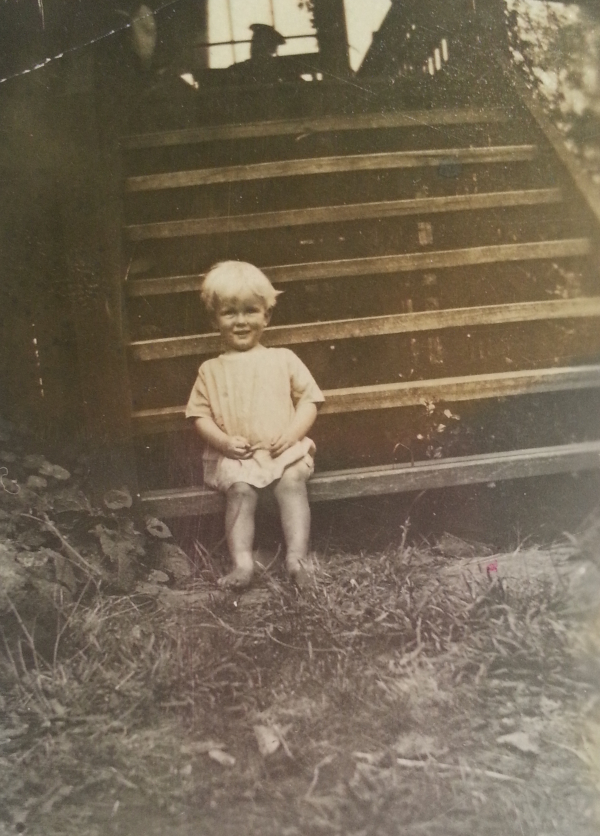
1920s My father Noel on Talisman steps
Photo by Tom, or his son Caleb (my grandfather)
Artist's collection, Sydney
I sat with my father on the back steps of Talisman, our home in Kallista. I was six years old. We were looking together at the garden and the bush beyond the house. My father said, "In nature there are no lines, just changes in tone and colour between things". I could see that in the paintings we had around the house, paintings by his grandfather Tom.
Then I thought about my mother working at the kitchen table, burning lines onto wooden boomerangs. Her lines looked like cellular structures I knew from a picture book I was given by Nobby, my father's sailor friend. I still have that book, The World We Live In. It's about what's known from science about the evolution of Earth. The pictures are colourful, detailed and animated.
That's my earliest memory of different ways of seeing,
and different forms of beauty.
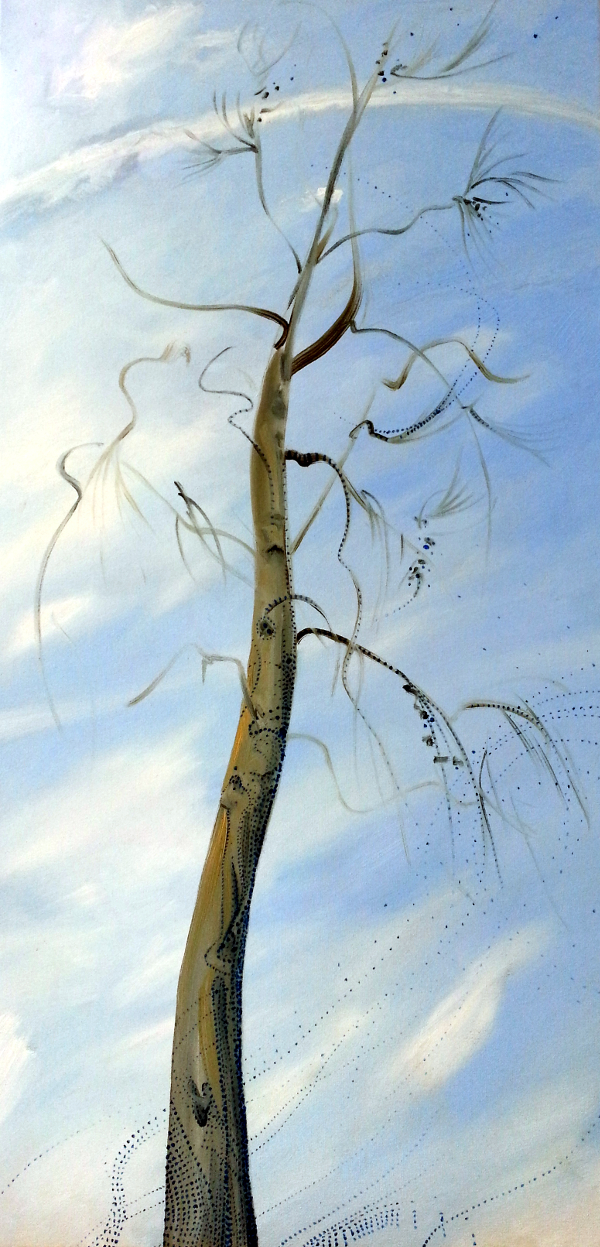
2017 Casuarina Living Data
450mm x 920 mm.
Oil on cotton duck
Rebecca Gibb collection, Canberra
Transformation Journey
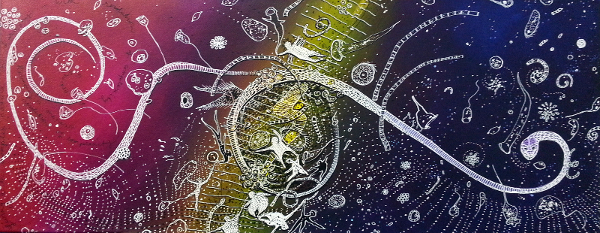
2017 Transformation Journey
Acrylic on cotton duck.
Private collection, Sydney
This year at Eora TAFE I study Aboriginal Cultural Arts, led by Chico Monks, I trace my part in nature through genetic ancestors, phytoplankton (microscopic plants) that transform sunlight into energy that sustains Life, and Antarctic krill (Euphausia superba), keytone creature of the Southern Ocean.
Chico's studio at Eora makes me think of the Aboriginal Enterprises studio where my mother worked with Bill Onus. Both studios seemed to me places for people to connect through making art to telling their stories. At home I sat with mum at our kitchen table and drew. I also drew on walls around the house, inside and out, using charcoal from the fireplace. Mum showed me how to mix and use paint, and ways to make small sculptures out of 'rubbish'. I watched as she worked with a "red hot poker" to burn designs into wooden boomerangs that Bill had made. She held my hand as she taught me how to similarly "write with fire" on scraps of wood.
Every second molecule of oxygen I breathe
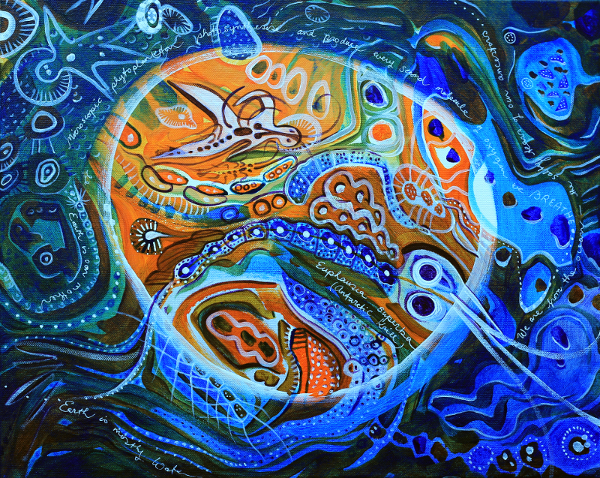
2017 Every second molecule of oxygen I breathe
Acrylic on cotton duck.
410mm x 510 mm
Private collection, Sydney
This is the first painting I did as a student of Eora College. Chico Monks was head of Vultural Arts. He encouraged us all to find our own ways to identify as artists. I painted the circle to represent both a microscopic and a global view of myself as part of nature, and painted words and other images to express the reality that every second molecule of oxygen we breathe is produced by phytoplankton (microscopic plants) in the ocean. The circle represents both myself and my origin as a creature in the sea.
Oceanic Light Painting
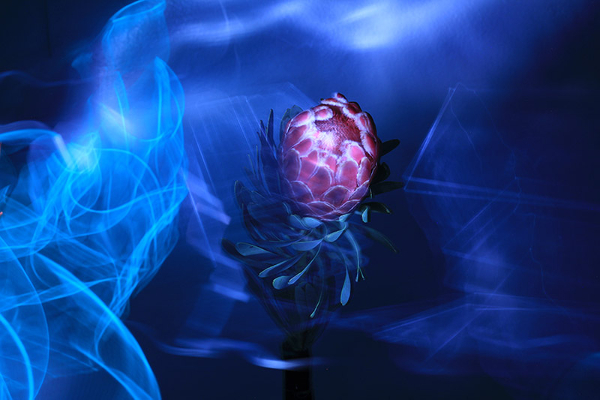
2017 Oceanic Light Painting
Protea Dance
Size variable.
Photograph.
With guidance from Peter Solness I paint with light.
I call this Oceanic Dreaming because for me the forms evolve from what the artist Len Lye describes as "the workings of the 'Old Brain' and genetic memory - that is, he saw the doodle as an intuitive visualisation of knowledge..." For me light painting is tracing and making visible relationships between bodies.


