Pictures 2002
Catalogue / Memoir
Introduction
Pictures
Objects
Animations
PICTURES are both finished and ephemeral works made for animations.
1949---- 1950---- 1951---- 1952---- 1953---- 1954---- 1955---- 1956---- 1957---- 1958---- 1959---- 1960---- 1961---- 1962---- 1963---- 1964---- 1965---- 1966---- 1967---- 1968---- 1969---- 1970---- 1971---- 1972---- 1973---- 1974---- 1975---- 1976---- 1977---- 1978---- 1979---- 1980---- 1981---- 1982---- 1983---- 1984---- 1985---- 1986---- 1987---- 1988---- 1989---- 1990---- 1991---- 1992---- 1993---- 1994---- 1995---- 1996---- 1997---- 1998---- 1999---- 2000---- 2001---- 2002---- 2003---- 2004---- 2005---- 2006---- 2007---- 2008---- 2009---- 2010---- 2011---- 2012---- 2013---- 2014---- 2015---- 2016---- 2017---- 2018---- 2019---- 2020---- 2021---- 2022---- 2023---- 2024---- 2025---- 2026----
Silence on deck
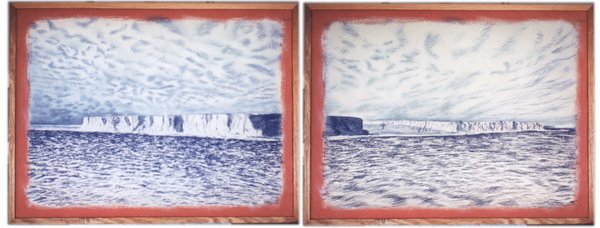
2002 Amery Ice Shelf, Antarctica. Dipych. Pastel on paper. Framed, glazed.
Australian Antarctic Division collection, Kingston, Tasmania
On February 8 2002 I arrive at the Amery Ice Shelf, Antarctica.
The day George Bush and John Howard announce they refuse to ratify the Kyoto Protocol.
I was part of an Australian Antarctic Division marine science voyage led by climatologist John A. Church. The purpose of the voyage was to collect data for long term programs to measure changes in the ocean: changes in water currents, temperature and chemistry, changes in sea level rise due to thermal expansion of the ocean, and changes in distribution and abundance of phytoplankton and krill.
We had traveled from Hobart on the Aurora_Australis icebreaker, across the Southern Ocean to the Amery Ice Shelf, then on to Mawson and Davis stations. A six week summer voyage.
My role as an Arts Fellow was to witness, experience, learn and make art that contributes to better understand, value and protect Antarctica and the Southern Ocean. I was surprised to learn the vital roles of tiny creatures of the sea - Euphausia superba (Antarctic krill) and phytoplankton - in maintaining ocean health. Collectively krill move up and down the water column and stir up nutrients from the sea floor. Phytoplankton produce every second molecule of oxygen we breathe. That voyage changed my life. I am now part of an interconnected global community of individuals working in different ways to make visible something of the massive unseen forces that interact to sustain life on earth.
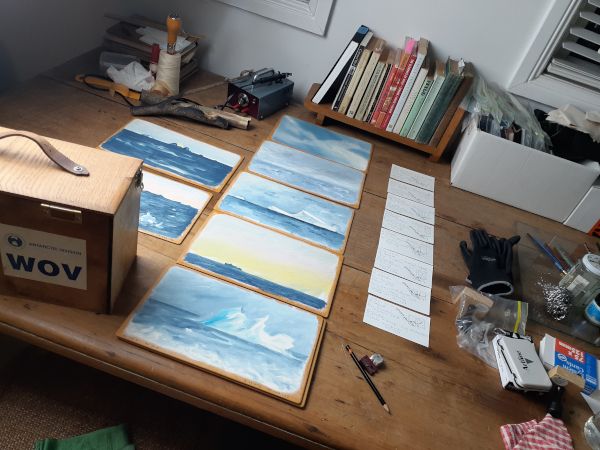
2002 WOV: Wanted On Voyage
Wooden box for holding 9" x 5"
wooden boards for painting.
Designed and made by Tasmanian artist Kim Henry.
Artist's collection, Sydney
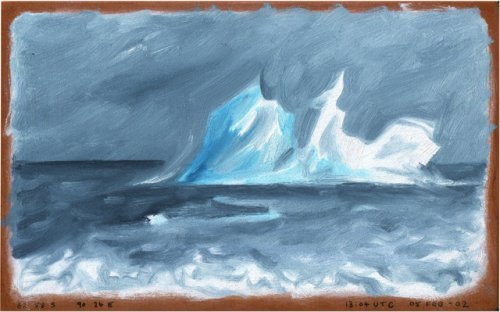
2002 Sapphire Berg, Antarctica 9" x 5" Oil on wood
Artist's collection, Sydney
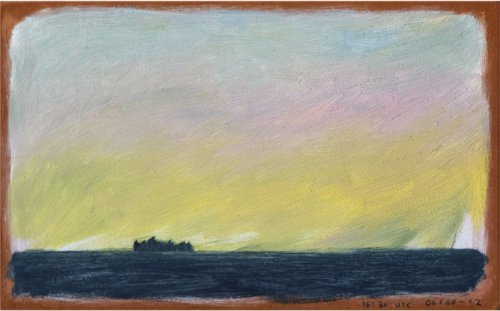
2002 Sawtooth Berg, Antarctica
9" x 5" Oil on wood
Artist's collection, Sydney
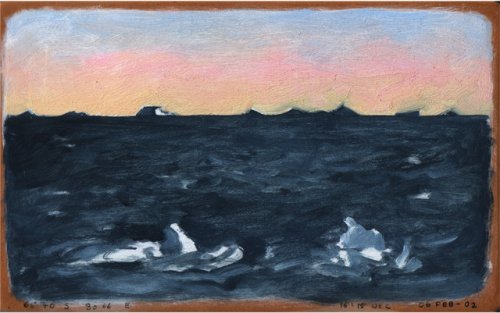
2002 Dark Sea, Antarctica 9" x 5" Oil on wood
Artist's collection, Sydney
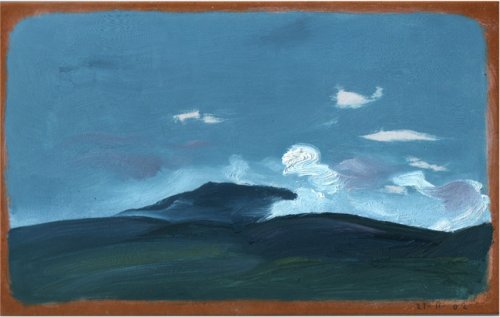
2002 Mount Berg, Tasmania. 9" x 5" Oil on wood
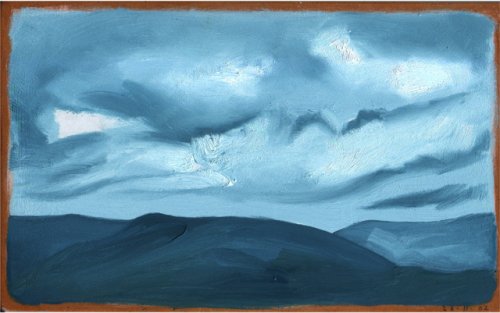
2002 Southern Skies, Tasmania. 9" x 5" Oil on wood
-web.jpg)
2002 Chaetognath (Arrow Worm) Antarctica. Pencil on paper.
-web.jpg)
2002 Calanus propinquus (Antarctic copepod) Antarctica. Pencil on paper.
Chaetognath (Antarctic Arrow Worm) and Calanus propinquus (Copepod) were drawn from life, looking through a microscope on board the Australian icebreaker Aurora Australis, on Voyaye 7, 2002.
These specimens were found in the Southern Ocean near Mawson station, Latitude 69 degrees south, Longitude 74 degrees east, on January 13th 2002. These are some of many species caught in plankton mesh and counted as part of the international Continuous Plankton Recorder (CPR) science research program that has been operating continuously since 1931. This unique and valuable data set tracks changes in the health of world's oceans. The CPR Survey's methods of sampling and plankton analysis remain unchanged since 1948, providing a spatio-temporally comprehensive > 70 year record of marine plankton dynamics. The CPR program is in dire straits due to withdrawals of government funding for climate science.
Because she is good with words and knows how I think, I ask my lifelong friend Anne to explain the freezing and thawing of the sea around Antarctica, and why salt is released and falls to drive cold bottom water circulation.
Anne writes from French Island:
Hi Lisa,
When water freezes it forms an open hexagonal lattice like a honey comb arrangement and this causes it to be less dense than the water it freezes from, and it floats on top. This is very fortunate, because if it actually fell to the bottom it would make an aquatic creature's life very perilous and krill would not be able to live in polar waters. Specially since krill hang out in ice caves in sea ice in the winter. But that's another story.
When salt water freezes some salt is caught up in the ice lattice, but at a lower concentration than the surrounding sea water. This means that the layer of water under the forming ice is at a higher salt concentration than lower water so it sinks and this fall drives global currents. Over time the salt ions leach out of the ice through imperfections in the ice lattice and into the sea below maintaining this effect.
An easy demonstration of density is to put a whole fresh egg in a glass of water and it will sink to bottom. As you add salt (and dissolve it) and increase the salinity of the salty water it becomes more dense until the egg will float. A bit like floating on the dead sea. Old fashioned recipes sometimes call for brine strong enough to float an egg.
I'm going to freeze some salt water and see what happens. I wish I had a salinity metre. It will be interesting to see just how salty the ice is and then to see if that changes over time. Also if it's saltier on the under side of the ice.
I had never really given this much thought before. I'm glad you asked because I love it.
Love, Anne
September 1, 2026.
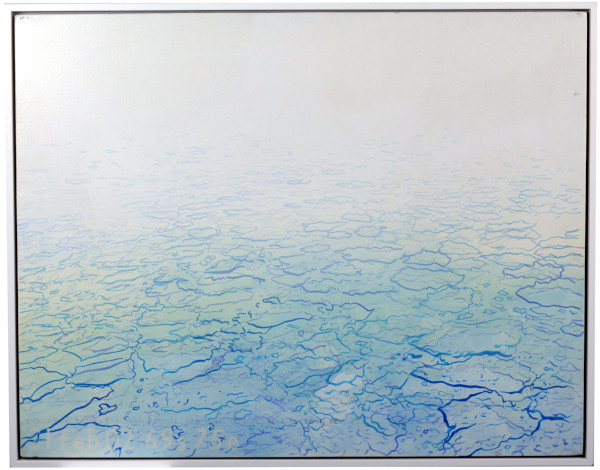
2002 Antarctic sea ice 01. Oil on canvas. Artist's collection, Sydney
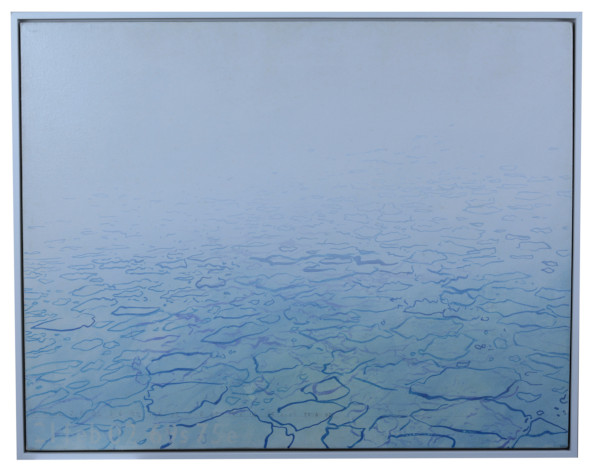
2002 Antarctic sea ice 02. Oil on canvas. Artist's collection, Sydney
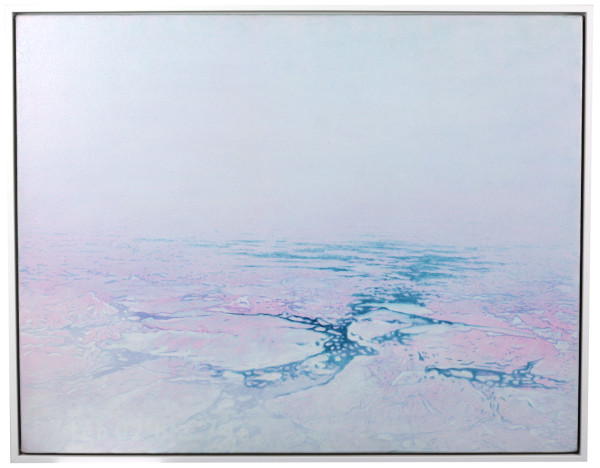
2002 Antarctic sea ice 03. Oil on canvas. Artist's collection, Sydney
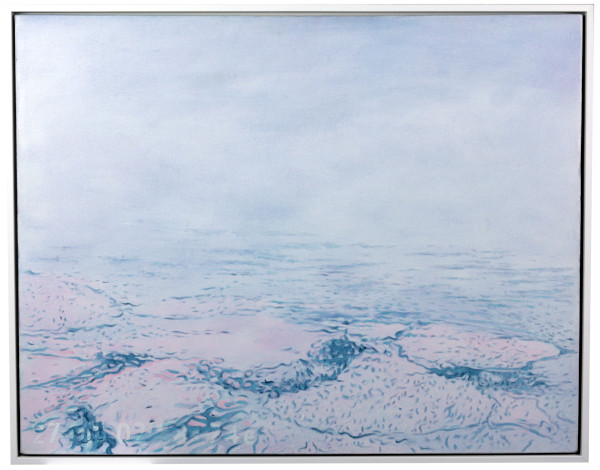
2002 Antarctic sea ice 04. Oil on canvas. Artist's collection, Sydney
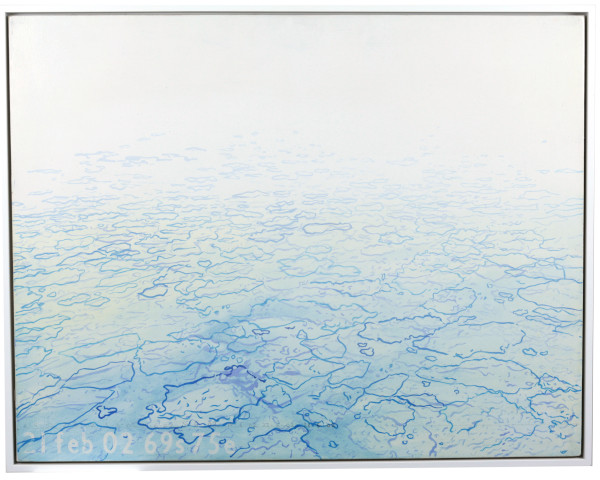
2002 Antarctic sea ice 05. Oil on canvas. Artist's collection, Sydney
EVENTS
WORLD IN BRIEF
NEWS VIA SATEL Aurora Australis
Latitude 62:46 south. Longitude 92:25 east
Bush budget boots defence
The effects of the September 11 attacks of the previous year had a significant impact on the affairs of 2002. The war on terror was a major political focus. Without settled international law, several nations engaged in anti-terror operations, and human rights concerns arose surrounding the treatment of suspected terrorists. Elsewhere, the Colombian conflict and the Nepalese Civil War represented some of the most severe militant conflicts, while the conflict between India and Pakistan was the only one between two sovereign nations. Religious tensions permeated the year, including violence between Hindus and Muslims in India during violent riots and other attacks and attacks on Jews in response to the Second Intifada. The Catholic Church grappled with scrutiny amid sexual abuse cases.
Politics and religion in the early months of 2002 is still focused intently on the Muslim world and Islamic terrorism over the September 11 attacks the previous year.
Timor-Leste was established as a new sovereign nation, and the African Union began operating as a new intergovernmental organization. The International Criminal Court was founded in July. The global economy was stagnant as it slowly moved past the early 2000s recession. South America endured an economic crisis, and the telecommunications and information technology industries faced their own economic declines. The Euro was introduced as a new currency at the beginning of the year.
The year 2002 was the second hottest on record at the time. Eruptions of Mount Nyiragongo severely affected surrounding populations in central Africa. The discovery of Quaoar in October challenged the conventional definition of a planet. Small RNA was discovered in 2002, and the human ancestor Sahelanthropus was first described. The Baiji dolphin was declared functionally extinct from the Yangtze River in China.
Written by me, Lisa Roberts/Euphausia superba (Antarctic krill), on
01/09/2026