
Pictures 1967
Catalogue / Memoir
Introduction
Pictures
Objects
Animations
PICTURES are both finished and ephemeral works made for animations.
1949---- 1950---- 1951---- 1952---- 1953---- 1954---- 1955---- 1956---- 1957---- 1958---- 1959---- 1960---- 1961---- 1962---- 1963---- 1964---- 1965---- 1966---- 1967---- 1968---- 1969---- 1970---- 1971---- 1972---- 1973---- 1974---- 1975---- 1976---- 1977---- 1978---- 1979---- 1980---- 1981---- 1982---- 1983---- 1984---- 1985---- 1986---- 1987---- 1988---- 1989---- 1990---- 1991---- 1992---- 1993---- 1994---- 1995---- 1996---- 1997---- 1998---- 1999---- 2000---- 2001---- 2002---- 2003---- 2004---- 2005---- 2006---- 2007---- 2008---- 2009---- 2010---- 2011---- 2012---- 2013---- 2014---- 2015---- 2016---- 2017---- 2018---- 2019---- 2020---- 2021---- 2022---- 2023---- 2024---- 2025---- 2026----
The librarian at school says to learn a new word every day.
1967 Hold Crayon on paper.
Joe Kiraly collection, Melbourne
I read from my father's library: Sigmund Freud, Joan Didion, Carson McCullers.
I hunt down books that might help me deal with my parents shouting.
During an op shop trip with my mother I find this book, Art of Conversation by Josephine Turck Baker (1873-1942). Bound in red, it somehow gives me comfort to imagine myself learning rules for civil conversations.
One morning I am specially upset about the fighting. I get to school and go straight to the art room. Drawing kind of calms me down. I kind of knew then, what this drawing meant but I didn't have words for it. Looking at it now, I recognise my teenage mind's interpretation of Freud's "archaeology of the mind": generations of myself holding me together - mother and child, my past, present and future selves.
The picture came easily. The waxy crayon knew where it was going, sliding confidently over the paper. Butchers paper, nothing special. But the feeling of lines flowing remains significant to me. As I drew I felt myself being held together in some kind of time zone where past, present and future co-exist.
Re-reading Didion's Slouching Towards Bethleham (1967) reflects back to me how I felt then, living within and beyond our small suburban home and our pretense of normal life. Although Didion wrote about America my feeling today is that Australia is moving in this direction.
The centre was not holding. It was a country of bankruptcy notices and public auction announcements and commonplace reports of casual killings and misplaced children and abandoned homes and vandals who misspelled even the four-letter words they scrawled.
From Slouching Towards Bethleham (1961)
by Joan Didion
1967 My brother Tom Pencil on paper.
Tom Roberts collection, Melbourne
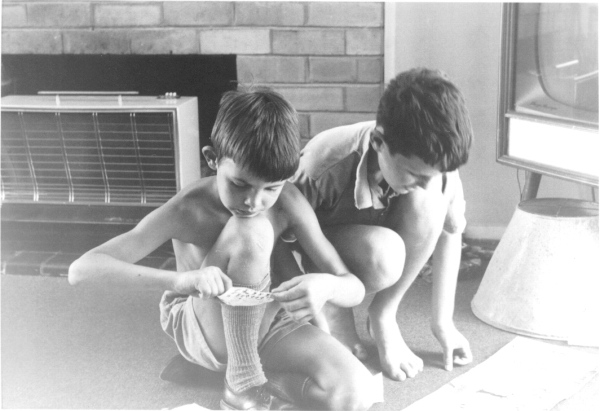
1967 Photo: Noel. Tom, friend, and TV
Glen Waverley
Brother Tom would lie on the living room couch with his legs over the back rest, watching TV. Or he would make things, alone and with friends. Always doing something, he was the perfect model for me who loved to draw movement.
In the 1950s Noel took me to see the Russian ballerina Maya Plisetskaya perform in Melbourne. She danced "the dying swan". For my birthday he gave me a large black and white photo of her final pose on the floor, with crossed legs and arms folded as wings. He'd bought the photo from The Age newspaper, enlarged and mounted on board. He hung it on my bedroom wall. For many years I was memerized by that swan, and my memory of seeing her whole body quivering, and the final twitching of her neck before she died.
Plisetskaya trained in the Vaganova method of dance, a method that engages the whole person - body, mind and spirit - the same method I was taught in the 1960s at the Victorian Ballet Guild, by Laurel Martyn and Valerie Grieg. In 1964 Margot Fonteyn and Rudolf Nureyev came and watched our class. Years later I recognised a similar wholistic approach in the choreographies of Gertrud Bodenwieser that I had learned from her students Hanny Exhiner and Barbara Cuckson - all strong, intelligent women breaking free from oppression.
At high school a small boy with blue eyes and freckles looks up at me. He's wearing short trousers. I swear he was. Years later Andrew Morrish denies wearing short school trousers. Did I imagine that?
I injure both my knees. One from dancing, the other from helping to drag a boy's board over sand, quickly so he could race in some surfing competition. After knee operations I was told to stop dancing. So instead of going to after school ballet classes I join night classes in drawing at the National Gallery School of Art. John Brack is Head of School and soon I would become his nude model.
EVENTS
Population estimated at 11,928,889.
Gough Whitlam replaces Arthur Caldwell as leader of the Australian Labour Party.
1967: Referendum confirmed by a 90.8 per cent 'yes' vote to end all forms of discrimination against Aborigines. Aborigines counted in national census for the first time and amendment of Section 51 of Constitution enabled Commonwealth Government to legislate for Aborigines in the states along with the State Governments.
1967: Prime Minister Harold Holt disappeared off the coast of Victoria at Portsea.
1967: The Australian Reform Movement, a splinter group of the Liberal Party, which opposed the war in Vietnam and Australia's involvement in it, was set up.
1967: Despite opposition from the conservationist bodies, Qld granted exploratory oil-drilling permits for large areas of the Barrier Reef. Public opposition to drilling grew over the next years and in 1970 a black-ban on the reef was recommended.
1967: Postcode system for mail introduced.
1967: The Australian-United States Joint Space Facility was established at Pine Gap, south west of Alice Springs.
The Australian Almanac, Pub. Angus & Robertson 1985
Written by me, Lisa Roberts/Euphausia superba (Antarctic krill) , on
23/08/2026
Read by you on


