Pictures 1969
Catalogue / Memoir
Introduction
Pictures
Objects
Animations
PICTURES are both finished and ephemeral works made for animations.
1949---- 1950---- 1951---- 1952---- 1953---- 1954---- 1955---- 1956---- 1957---- 1958---- 1959---- 1960---- 1961---- 1962---- 1963---- 1964---- 1965---- 1966---- 1967---- 1968---- 1969---- 1970---- 1971---- 1972---- 1973---- 1974---- 1975---- 1976---- 1977---- 1978---- 1979---- 1980---- 1981---- 1982---- 1983---- 1984---- 1985---- 1986---- 1987---- 1988---- 1989---- 1990---- 1991---- 1992---- 1993---- 1994---- 1995---- 1996---- 1997---- 1998---- 1999---- 2000---- 2001---- 2002---- 2003---- 2004---- 2005---- 2006---- 2007---- 2008---- 2009---- 2010---- 2011---- 2012---- 2013---- 2014---- 2015---- 2016---- 2017---- 2018---- 2019---- 2020---- 2021---- 2022---- 2023---- 2024---- 2025---- 2026----
First lunar landing, first day at art school
On July 20, 1969, TV screens flicker around the world.
As the first men walk on the moon, I walk the back streets of Melbourne to the National Gallery Art School. The day is cold, grey and wet as I maneuver a large folio of my drawings.
I didn't have an appointment or anything. I just walked in off the street. I knew my way around. I knew the teachers from the night classes I attended there when I traveled by train from Glen Waverley High School.
Before leaving High School I'd won a Commonwealth Scholarship to study for a Bachelor of Arts at Melbourne University. At the time of the lunar landing I was in the middle of that study and loving the challenge. My small world expanded and my confidence grew.
Things were different then. With this scholarship I could study subjects for pure interest, with no expectation I would be locked into a profession, unlike the funding available to people who knew they wanted to be teachers. I always knew I was an artist.
I wanted to jump ship from uni and go full-time to the art school.
The school was in the basement of the Melbourne Museum and Library. It's the old blue-stone building where I went for night classes while I was at High School. On this day I was interviewed by Lenton Parr, the new Head of School, and teachers I knew from Night School. I was accepted and enrolled that day.
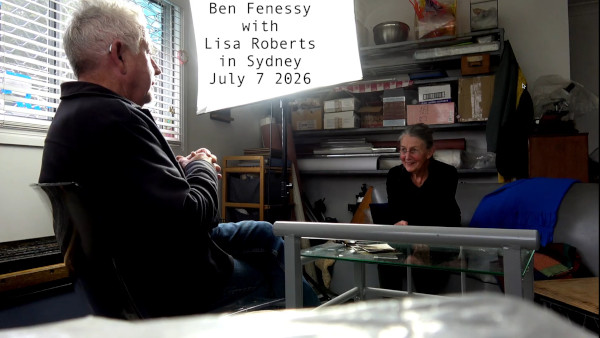
I swap notes with Ben Fenessy
about our experience as students
at the National Gallery Art School.
Watch on Youtube:
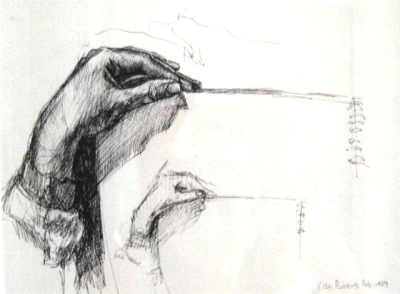
1969 Hand Drawing (self)
Pencil on paper.
Tom Roberts collection, Melbourne
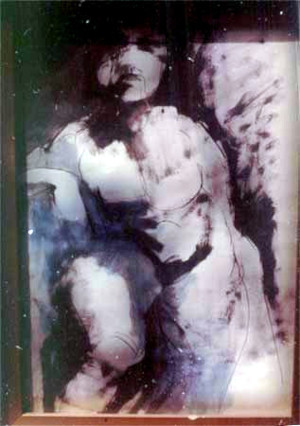
1969 Blue Nude.
Pen, ink, blue wash on paper.
Made in life drawing class,
National Gallery Art School, Melbourne.
Ex Wesley College art show.
Private collection, Melbourne
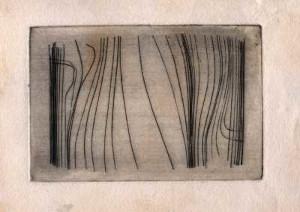
1969 Fronds. First copper engraving made at the National Gallery Art School with teacher Murray Walker. Provenance unknown
At the National Gallery Art School Murray Walker taught printmaking. He taught me how to polish copper plates and engrave the soft metal with a burin.
When Grandpa Ca died some time before this, I lived for a time with Grandma Nora, and her boarder David Carter, a glaciologist just returned from Antarctica and wtiting up his thesis.
Nora told me her mother Louise named her after Nora in Ibsen's play, The Doll's House, and that Louise hosted Fabian Society meetings at their home in London. Learning this made sense of Nora's position in my family, and of the books she gave me to read and critically discuss with her, books by George Bernard Shaw, Bertrand Russell, Rudyard Kipling, and others.
I was in my 20s and thought I knew everything. I still have those books and read them now with deep regret about my young, know-all, arrogant self.
I had got a scholarship to University of Melbourne and studied Philosophy, English, Italian, Fine Art, and History and Philosophy of Science, and also Fine Arts at the National Gallery School of Art.
"Foghorn" was the nickname Nora's family gave her. I remember her voice well: a strong, deep sound I image could pierce through miles and miles of London fog. She described her voice as contralto.
1969 Ian Goding playing Elgar 01. Pencil on paper. Artist's collection, Sydney
Drawn from life
1969 Ian Goding playing Elgar 02. Coloured pens on paper. Artist's collection, Sydney
Drawn from life
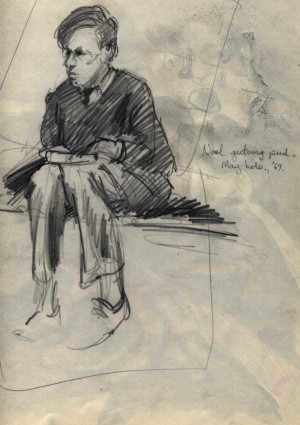
1969 Noel. Pencil on paper.
Artist's collection, Sydney
Drawn from life
STORY
One day Carmel Bird came to visit the Goding's house in Mount Waverley. I wasn't sure how she knew the Goding family. I took it she was an old friend. It was just me in the house that day. I was in the basement sharpening pencils. She came down and I spent the whole afternoon drawing her portrait. I can still see that drawing and keep hoping it will turn up as I sort all the things that came over from Launceston last year in the shipping container.
EVENTS
Foucault's cultural relativism was in accord with Derrida's linguistic relativism. Both were seen as leaders in the movement known as post-structuralism, which regarded all knowledge as textual (i.e., a relative interpretation of text). History, psychology, philosophy, anthropology - all these dealt not so much with concepts but with words. For Foucault this led to epistemes (or paradigms) of knowledge in which power was invested. These structured the thinking of any given age, directing the way in which it thought, and thus determining what it thought about, the aims of its thought, the lacunae (blanks, missing bits) of that thought, even ruling out the possibility of thinking in certain ways. For instance, the mediaeval era, which believed that the world ultimately consisted of earth, air, fire and water, and mixtures thereof, simply could not conceive of atomic elements. With the advent of each new era - such as the transformation from the Renaissance to the Age of Reason - an entirely new episteme (knowledge basis) of thought was established. Foucault saw Descartes as the epitome of the Age of Reason. After using one reason to doubt everything, to unpick the very fabric of his existence (and by implication the certainties of the previous age and its episteme), Descartes had arrived at his basic certainty: 'I think therefore I am'. But Derrida took issue with Foucault's analysis. In using the language of reason to describe Descartes's method, Faucault had himself subscribed to the episteme of the Age of Reason. Descarte's doubt had in fact unwittingly undermined the very reason it sought to establish as paramount. Reason too could be doubted. Descartes's text was open to a far more drastic interpretation that the one placed on it by Foucault. It was a delusion to assume that thought can use a language that stands 'outside' the very language it describes.
Foucault not surprisingly reacted with some passion to this critique, which threatened to undermine his entire intellectual project (and, it would seem, any other intellectual project). In foucault's view, Derrida's nit-picking attack was just an intellectual game. This spat eventually led to a split in the entire post-structuralist approach.. while foucault retained the emphasis on the text, expecially the historical document, he insisted that it was possible to anlayse the power structure adherig to a particular text. The episteme that controlled and limited its writing implied a system of political power. Such a historical text was open to a particular interpretation. Derrida insisted that, like any text, it was open to a multitude of interpretations. The view of any historical document was liable to change from age to age. This may have freed the text from a single authoritative interpretation, but it left Derrida open to the charge that such a text could seemingly be given any interpretation.
Strathern, Paul, 2003, p.27-8, The Essential Derrida, Virgin, .
Derrida's divergence of opinion from his Parisian countempoary Roland Barthes was less violent and apparently less fundamental. Barthes was the champion of semiology, whereby a text is studied for its 'second order' meaning. Intellectual innocents who read a text in order to discover its author's intentions were dismissed as hopelessly naive. The real meaing of any text lay in the analysis of the symbols and interconnected signs whose structure underlay the surface. Barthes daringly extended such analysis far beyond the texts of philosophy and literature, into such diverse realms as fashion, the Eiffel Tower, and even wrestling (where all manner of interconnected signs were to be found grappling beneath the surface).
This method of analysis led Barthes to announce the 'death of the author'. What he (or she) said didn't count. The author was merely a cultural construct: the product of an age, class, sex, socially determined expectations, and appetites, and so forth. At its best, Barthe's analysis showed how surface language could overlay a hidden structure of assumptions, making these wholly artificial assumptions appear 'natural', 'universal', or even inevitable. This was the case, for instance, with the bourgeoise novel and the unquestioned cultural values upon which it rested.
Derrida had mixed feelings about the so-called 'death of the author'. He naturally applauded Barthes for stripping bare hidden assumptions and revealing how the 'universal truths' of bourgeois values were in fact no more than an arbitrary construct of prejudices and assumptions. This coincided with his own deconstructionist approach. Here was more evidence of the transcendental 'presence' of Western metaphysics. It was always necessary to expose the 'truth' as purely humanistic. On the other hand, Derrida deplored any assumption that such criticism itself could go beyond the humanistic and, so to speak, emerge 'on the far side' of humanistic ideology, that one day it would be possible to make judgments entirely free from humanism and its inevitable bias. This was impossible. The very language in which such criticism was couched would inevitably contain traces of the humanistic assumptions on which it was based, on which it had grown throughout its history. This argument may sound somewhat circular, but the point was clear enough. We are bound within the circularity of our discourse. Our speech will always be subject to the language we use. We can never step outside its inevitably humanistic colouring. This may appear depressing with regard to any notion of truth beyond the socially agreed construct. Yet it does have distinctly hearteningly implications. The truth as we know it, in the only way we can know it, must remain humanistic. It must remain 'of the human, for the human'. Unfortunately, as recalcitrant deists and meta physicians are quick to point out, the same can be said of of the metaphysical and religious assumptions that have for so long been a part of our language. Derrida argues that we can never get rid of this 'presence', yet at the same time he argues that we can never get rid of the human 'presence'. It is difficult to see how he can have it both ways - except of course in the realm of 'free interpretation' he advocates, which is presumably free to contradict itself.
Strathern, Paul, 2003, p.28-9, The Essential Derrida, Virgin.
Mining company Poseidon NL announced the discovery of a mmajor nickel lode at Windarra, Western Australia. By the end of the seventies Australia was producing approximately 11 per cent of the world's nickel, the biggest producer being Western Mining Corporation.
Standard gauge railway completed, creating a complete and unbroken line from Sydney to Perth.
Mount Newman began iron-ore production, transporting over 30 million tonnes of ore annually through Port Hedland from the world's largest open cut iron ore mine.
The principle of 'equal pay for equal work' established by the Commonwealth Arbitration Commission.
Hair performed in Sydney.
The Australian Almanac, Pub. Angus & Robertson 1985
Written by me, Lisa Roberts/Euphausia superba (Antarctic krill), on
20/04/2026