Pictures 1970
Catalogue / Memoir
Introduction
Pictures
Objects
Animations
PICTURES are both finished and ephemeral works made for animations.
1949---- 1950---- 1951---- 1952---- 1953---- 1954---- 1955---- 1956---- 1957---- 1958---- 1959---- 1960---- 1961---- 1962---- 1963---- 1964---- 1965---- 1966---- 1967---- 1968---- 1969---- 1970---- 1971---- 1972---- 1973---- 1974---- 1975---- 1976---- 1977---- 1978---- 1979---- 1980---- 1981---- 1982---- 1983---- 1984---- 1985---- 1986---- 1987---- 1988---- 1989---- 1990---- 1991---- 1992---- 1993---- 1994---- 1995---- 1996---- 1997---- 1998---- 1999---- 2000---- 2001---- 2002---- 2003---- 2004---- 2005---- 2006---- 2007---- 2008---- 2009---- 2010---- 2011---- 2012---- 2013---- 2014---- 2015---- 2016---- 2017---- 2018---- 2019---- 2020---- 2021---- 2022---- 2023---- 2024---- 2025---- 2026----
I am married.
Noel gives me The Female Eunuch and a Revox tape recorder.
An art school friend gives me A NET OF FIREFLIES.
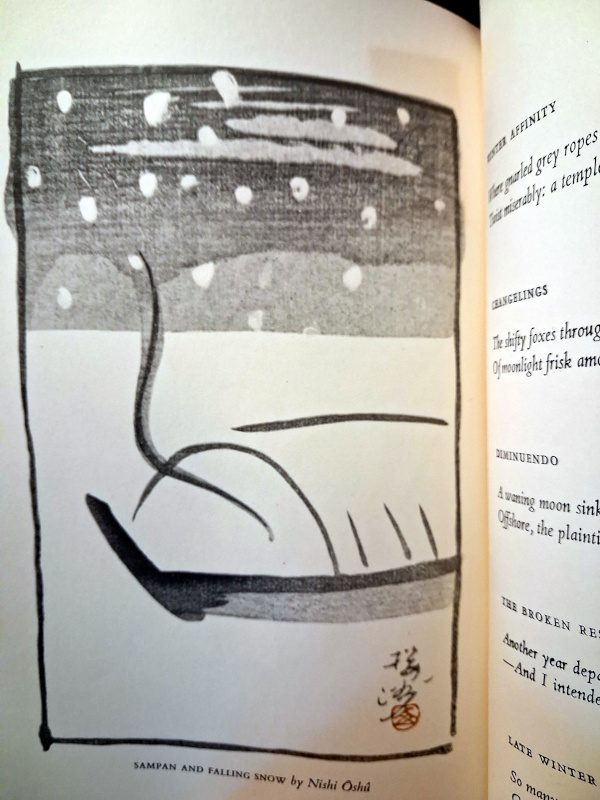
1970 Sampan and falling snow
by Nishi Oshu in A NET OF FIREFLIES p.112
Artist's library, Sydney
I marry Ian, son of my father's ham radio friend Jim Goding, and brother of Geoff Goding, my sister Nadya's first psychiatrist. Ian and I can now leave home. We rent a flat that belongs to the family of one of Ian's school friends. The Brown family. The flat we rent from the Browns was once the home of Phil Hudson, the architect who the designed, with James Wardrop, the Shrine of Remembrancein St Kilda Road Melbourne. The flat has enormous plan draws that I use for storing my drawings.
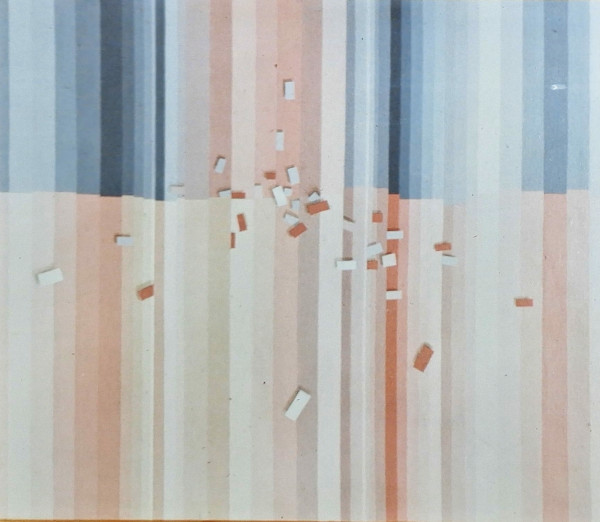
1970 Tiny things
Acrylic on cotton duck. 35 x 300 cm
Peter Goding collection, Tasmania
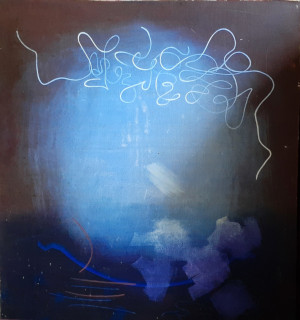
1970 Ocean.
Acrylic on cotton duck
Lake Tyers House collection, Victoria
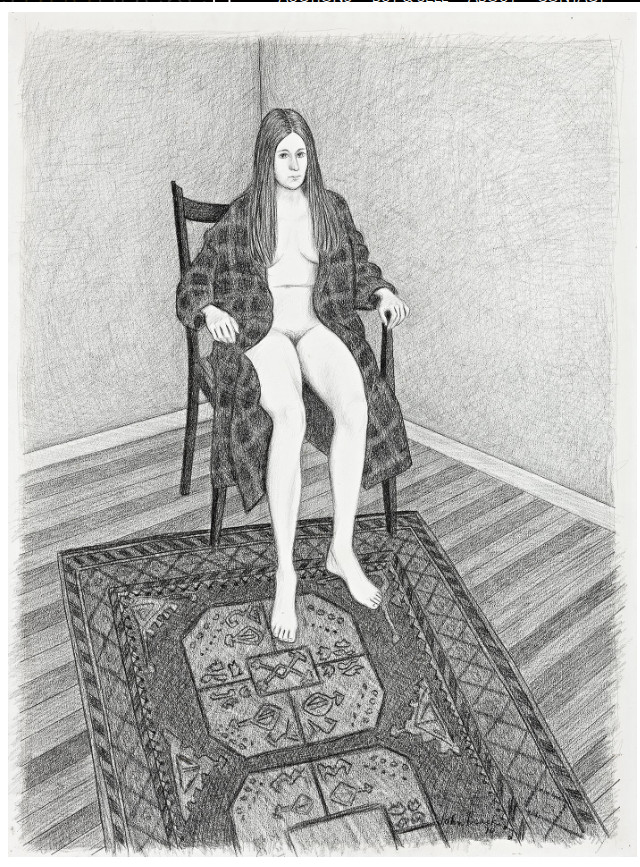
1970 Drawing of me by John Brack
See ENDNOTE *below
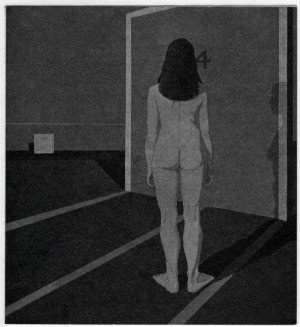
1970 Painting of me by William Kelly
Photo from William Kelly exhibition catalogue
The National Gallery Art School where I study is relocated to St Kilda Road Melbourne and re-named the Victorian College of the Arts (VCA). The first director is the sculptor Lenton Parr. Parr conceived the vision for the school with Antarctic scientist Phil Law, the first director of the Australian Antarctic Division. Inspired by the Bauhaus school of thought, their vision was to educate men and women across cultures and generations, through art, science and technology.
EVENTS
1971: I'm either pregnant or just plain getting fat - but anyway the shape of my body is changing strangely. Not enough exercise?
Euphausia's secret diary
Tuesday 10th August, 1971
1970: Australia's population reached 12 million.
1970: The discovery of a cluster of bones at Lake Mungo proved the Aboriginal people had been living in Australia longer than previously thought. Evidence was uncovered for the human occupation of Australia 40,000 years ago.
1970: Australian forces in Vietnam rose to over 8,000 men as opposition grew within Australia.
The Australian Almanac
Pub. Angus & Robertson 1985
In May 1968 Paris was overtaken by 'Les evenements' (literally the incidents, or events). Students took to the streets in conflict with the police, and the Left Bank became the scene of viscious day and night riots...the country was brought to a virtual standstill. Many supported the students but feared the collapse of the state. The explosion of youth violence arose as a result of years of authoritarian state rule, culminating in the sterility resulting from ten years of patriarchal government by the aging General Charles de Gaul.
In America, Britain, Germany, and elsewhere, the social and cultural transformations of the sixties were underway. Mass demonstrations against nuclear weapons and the Vietnam War, the revolution in social mores accompanying the arrival of rock music and the hippie movement, as well as the advents of postwar affluence had brought little change in France. The educational system, especially, maintained a strong grip on young people. The school curriculum was rigid in the extreme, culminating in the dreaded baccalaureat exam which marked out success or failure for life. Indeed, the curriculum was so fixed that the minister of education could be certain, at any given hour on any given day, precisely which page of which textbook was being studied in every classroom throughout the land.
The new post-Sartre wave of Parisian thinkers - such as Foucault, Barthes, Derrida, and others associated with the Tel Quel - represented the intellectual protest against the sterility of French society. In such a context it is easier to understand some of the excesses of the movement. Derrida's insistence upon the 'fluidity' of language becomes more comprehensible when seen against a background of the authauritarian edicts of the French educational system. His insistence upon the 'difference' of language, instead of the identity of words with their subjects, subverts the prevailing linguistic orthodoxy. This was, and still is, the preserve of the Academie Francaise, which continues to deliver its pronouncements on French linguistic purity (such as the exclusion of 'Americanisms' and other English words) and the precise meaning of French words. Such constraint produces an intimate sense of oppressiveness. It strikes at the very way one thinks, reaching into the mind itself.
On the contrary, English speakers, whose language has retained its far-flung homogeneity precisely through its ability to adapt, absorb, and withstand. (By contrast, consider the fate of Arabic. Classical Arabic script remains comprehensible from Morocco to the Phillipines; yet spoken variants on arabic can be all but incomprehensible from one country to the next.)
By the middle of the twentieth century, American English had begun breathing new life into the moribund formality of the English that was the lingua franca throughout the British Empire (over a third of the globe). And, arguably, that same English had already contributed a range of articulacy and discipline to the fecund variety of American, Indian, Australian, and African variants, holding the whole together. Precisely this fact has prompted many of Derrida's American critics to see his strictures on language, and their philosophical implications, as irrelevant to the English speaking world. We already know how language can take on a life of its own, how words can aquire new cadences or even entirely new meanings. One has only to consider such words as gay, freak, challenged to see how English is in a constant state of flux. Derrida in many ways was fighting for a freedom that English-speakers take for granted. Yet this was of course not his central aim - which was to show that all language was fluid through and through.
Strathern, Paul. 2003
The Essential Derrida
Pub. Virgin. pp. 22-5
ENDNOTE*
10. JOHN BRACK (1920 - 1999)
STUDY FOR THE RED CARPET, 1970. Conte on paper. 78.0 x 58.0 cm
signed and dated lower right: John Brack / 70
Estimate: $25,000 - 35,000
Sold for $48,800 (inc. BP) in Auction 44 - 13 September 2016, Sydney
Provenance
Rudy Komon Gallery, Sydney
Gwen Frolich, Sydney
Thence by descent
Private collection, Sydney
Exhibited
John Brack, Rudy Komon Gallery, Sydney, 7 - 28 April 1971, cat. 17 John Brack Drawings 1945 - 79, Monash University Exhibition Gallery, Melbourne, 9 June - 10 July 1981, cat. 40
Literature
Grishin, S., The Art of John Brack, Oxford University Press, Melbourne, 1990, vol. II, cat. p144, pp. 57, 216 (illus.) Lindsay, R., John Brack: A Retrospective Exhibition, National Gallery of Victoria, Melbourne, 1987, p. 133
Related works
The Red Carpet, 1970, oil on canvas, 164.0 x 97.1 cm, collection of the Art Gallery of Western Australia, in Grishin, vol. II, cat. o181, p. 25
Catalogue text
In the winter of 1970 Brack made eight conte drawings of the nude from the model and the following summer, working from these drawings, executed a series of eight oil paintings. It was his normal working procedure to use the model for the drawings and then, without the model, take the drawings as his point of departure for the paintings... 1.
The new series of nudes, when compared with the two series that preceded it, has a startling complexity, sophistication and subtlety. The conceptual elements remain relatively constant. The nude, who in her pose frequently echoes an artistic convention, generally refers to the past and to tradition; the bare studio with its naked walls and plain receding floorboards, refers to reality and the present situation; while the oriental carpet - the carpet paradigm - as if separating the two worlds nevertheless forms a strange physical bridge between them...
1. Grishin, S., The Art of John Brack,
Oxford University Press, Melbourne, 1990,
vol. 1, pp. 117 - 118
Written by me, Lisa Roberts/Euphausia superba (Antarctic krill), on
20/04/2026