Pictures 1968
Catalogue / Memoir
Introduction
Pictures
Objects
Animations
PICTURES are both finished and ephemeral works made for animations.
1949---- 1950---- 1951---- 1952---- 1953---- 1954---- 1955---- 1956---- 1957---- 1958---- 1959---- 1960---- 1961---- 1962---- 1963---- 1964---- 1965---- 1966---- 1967---- 1968---- 1969---- 1970---- 1971---- 1972---- 1973---- 1974---- 1975---- 1976---- 1977---- 1978---- 1979---- 1980---- 1981---- 1982---- 1983---- 1984---- 1985---- 1986---- 1987---- 1988---- 1989---- 1990---- 1991---- 1992---- 1993---- 1994---- 1995---- 1996---- 1997---- 1998---- 1999---- 2000---- 2001---- 2002---- 2003---- 2004---- 2005---- 2006---- 2007---- 2008---- 2009---- 2010---- 2011---- 2012---- 2013---- 2014---- 2015---- 2016---- 2017---- 2018---- 2019---- 2020---- 2021---- 2022---- 2023---- 2024---- 2025---- 2026----
Uncommonplace art and science
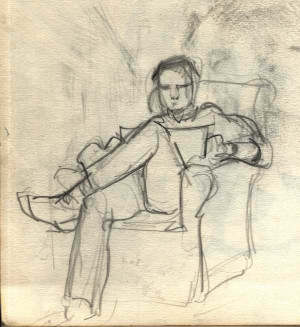
1968 Antarctic scientist David Carter
Pencil on paper. Artist's collection, Sydney
For most of 1968 I live with grandma Nora and her boarder David.
David is a glaciologist just returned from Antarctica.
He is writing a thesis based on his research there.
Nora's place is close to Melbourne Uni where he and I study, and close to the National Gallery School of Art where I am now also a day student.
Nora's place is perfect for thinking, writing, discussing and doing.
In Antarctica David lived for months in a tent with just two men.
They measured changes of movement in glacial ice.
Their work was part of a global study of changes in earth's climate.
Nora and I introduce David to art.
David introduces us to Antarctic science.
One afternoon Noel takes me to visit his ham radio friend Jim Goding. Jim is the brother of Geoff Goding, Nadya's first psychiatrist. I meet Jim's son Ian and I'm fascinated to find he's a serious student of both engineering and cello. While Noel and Jim talk about electronics, Ian and I talk about art and science and many other things. That night Ian takes me to my first live performance of classical music. It's a warm still night and we lie on grass looking up at the stars. Ian introduces me to his friends and we talk together before the musicians appear on stage. We're at the Sydney Myer Music Bowl, one of the engineering structures my grandfather Ca helped create. Part of me feels right at home here in this place. Proprietorial in fact. Then the music starts and my whole being rises to another space entirely, a whole new world.
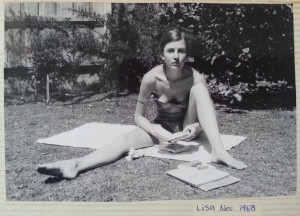
1968. Reading at home in Glen Waverley
Photo: Noel Roberts. Artist's collection, Sydney
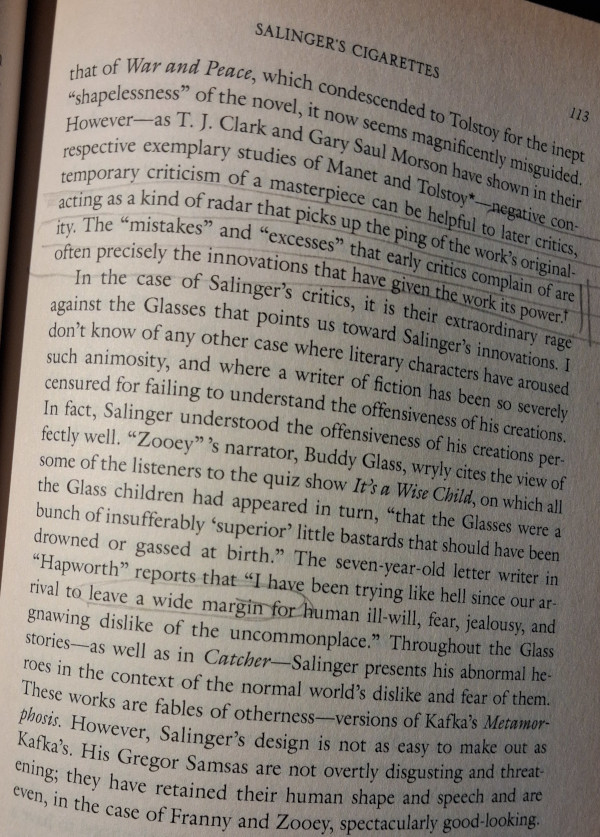
1968. Reading Salinger
Today in the Sydney Morning Herald I read (April 12, 2026):
"On Christmas Eve in 1968, Apollo 8 astronaut William Anders took a photo that changed humanity's perception of the world. The image known as "Earthrise" showed our home planet as a half-illuminated sphere, slowly lifting itself above the Moon's cold horizon. As Anders scrambled for a colour film roll on the far side of the Moon, the planet he was photographing was in geopolitical turmoil.
The United States was mired in an increasingly unpopular war in Vietnam; Martin Luther King Jr and Robert F Kennedy had been assassinated; there was conflict and unrest in the Eastern Bloc, South Africa, Northern Ireland, India and beyond. Now in 2026, the Easter weekend produced images that will earn their own place in history. And once again, our troubled planet was placed spectacularly in its cosmic context by humans in a tin can 400,000 kilometres away.
ABC Radio National science editor Jonathan Webb,
Posted online 12 April 2026 at 4:30am
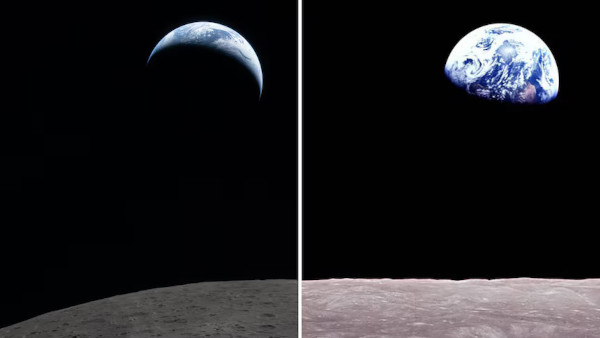
2026. The Earthset image
captured by the Artemis II crew (left)
is a deliberate echo
of the "Earthrise" photo (right)
taken from Apollo 8 in 1968.
(Supplied: NASA)
In 2003 Paul Strathern writes in his book, The Essential Derrida, Pub. Virgin:
In May 1968 Paris was overtaken by 'Les evenements' (literally the incidents, or events). Students took to the streets in conflict with the police, and the Left Bank became the scene of viscious day and night riots... the country was brought to a virtual standstill. Many supported the students but feared the collapse of the state. The explosion of youth violence arose as a result of years of authoritarian state rule, culminating in the sterility resulting from ten years of patriarchal government by the aging General Charles de Gaul.
In America, Britain, Germany, and elsewhere, the social and cultural transformations of the sixties were underway. Mass demonstrations against nuclear weapons and the Vietnam War, the revolution in social mores accompanying the arrival of rock music and the hippie movement, as well as the advents of postwar affluence had brought little change in France. The educational system, especially, maintained a strong grip on young people. The school curriculum was rigid in the extreme, culminating in the dreaded baccalaureat exam which marked out success or failure for life. Indeed, the curriculum was so fixed that the minister of education could be certain, at any given hour on any given day, precisely which page of which textbook was being studied in every classroom throughout the land.
The new post-Sartre wave of Parisian thinkers - such as Foucault, Barthes, Derrida, and others associated with the Tel Quel - represented the intellectual protest against the sterility of French society. In such a context it is easier to understand some of the excesses of the movement. Derrida's insistence upon the 'fluidity' of language becomes more comprehensible when seen against a background of the authauritarian edicts of the French educational system. His insistence upon the 'difference' of language, instead of the identity of words with their subjects, subverts the prevailing linguistic orthodoxy. This was, and still is, the preserve of the Academie Francaise, which continues to deliver its pronouncements on French linguistic purity (such as the exclusion of 'Americanisms' and other English words) and the precise meaning of French words. Such constraint produces an intimate sense of oppressiveness. It strikes at the very way one thinks, reaching into the mind itself.
On the contrary, English speakers, whose language has retained its far-flung homogeneity precisely through its ability to adapt, absorb, and withstand. (By contrast, consider the fate of Arabic. Classical Arabic script remains comprehensible from Morocco to the Phillipines; yet spoken variants on arabic can be all but incomprehensible from one country to the next.)
By the middle of the twentieth century, American English had begun breathing new life into the moribund formality of the English that was the lingua franca throughout the British Empire (over a third of the globe). And, arguably, that same English had already contributed a range of articulacy and discipline to the fecund variety of American, Indian, Australian, and African variants, holding the whole together. Precisely this fact has prompted many of Derrida's American critics to see his strictures on language, and their philosophical implications, as irrelevant to the English speaking world. We already know how language can take on a life of its own, how words can aquire new cadences or even entirely new meanings. One has only to consider such words as gay, freak, challenged to see how English is in a constant state of flux. Derrida in many ways was fighting for a freedom that English-speakers take for granted. Yet this was of course not his central aim - which was to show that all language was fluid through and through.
Strathern, Paul, 2003, pp. 22-5,
The Essential Derrida, Pub. Virgin.
Australia's population reached 12 million.
The discovery of a cluster of bones at Lake Mungo proved the Aboriginal people had been living in Australia longer than previously thought. Evidence was uncovered for the human occupation of Australia 40,000 years ago.
Australian forces in Vietnam rose to over 8,000 men as opposition grew within Australia.
The Australian Almanac,
Pub. Angus & Robertson 1985
Written by me, Lisa Roberts/Euphausia superba (Antarctic krill), on
12/04/2026