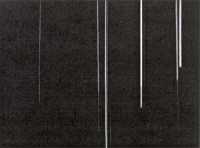
Tiny crystals of ice in cold air, brilliantly reflecting sunlight.
Image, Michaela Gleave (2006), words, Bernadette Hince (2000).
diamond dust noun
[is recorded later (fr 1978: DAlaskE) in Alaskan English.]
Tiny crystals of ice in cold air, brilliantly reflecting sunlight.
1958 Armstrong, Terence and Roberts, Brian in Polar Record 9(59) May: 94.
[glossary] Ice prisms: A fall of unbranched ice crystals, in the form of needles, columns or plates, often so tiny that they seem to be suspended in the air. These crystals may fall from a cloud or from a cloudless sky. They are visible mainly when they glitter in the sunshine (diamond dust); they may then produce a luminous pillar or other halo phenomena. This hydrometeor, which is frequent in polar regions, occurs at very low temperatures and in stable air masses.
1978 Bechervaise, John Science: men on ice in Antarctica. Australian Life Series Lothian Publishing Co, Melbourne: 24.
When the temperature is very low snow forms and falls as very small dry stars - 'diamond dust'. Wheeler, Sara Terra incognita: travels in Antarctica Jonathan Cape, London: 44. I took off in a helicopter with Ben, a geophysicist and Nino. The air was full of diamond dust.
The Antarctic Dictionary, Hince, 2000; 98
NOTES
Michaela Gleave, a Sydney based installation artist who is yet to go south, built an installation that provided a physical experience of a phenomenon she had researched and imagined: Diamond dust.
The installation, Raining room (diamond dust) was first exhibited in Sydney's Firstdraft gallery in 2006. Entering a darkened room, I walked through a veil of glistening light - waterdrops falling and side-lit by a bank of (hidden) slide projectors, and was imaginatively transported me into an Antarctic atmosphere.
L.R. March 2007